
For most people, the placenta is something associated only with childbirth — a temporary organ that nourishes and protects a baby during pregnancy. But for many donors and clinicians, the placenta represents something more: an opportunity to support patients through advanced biologic technology.
Tides Medical transforms donated placental tissue into meticulously processed, sterile grafts used in ocular surface applications. One of these products, Artacent® Ocular, is designed specifically for the delicate environment of the eye, providing a natural biologic covering that supports ocular surface procedures and overall tissue stability.
But how does donated placenta become a sterile, room-temperature–stable ocular graft? Below, we walk through the journey step-by-step: from donation, through Tides Medical’s proprietary Artacleanse® Process, to the final ready-to-use product.
Step 1: Donation — Ethical, Voluntary, and Safe
The journey begins at the moment of birth. Mothers delivering via C-section may have the option to donate their placenta through an established donation program partnered with Tides Medical. Donation is fully voluntary and does not affect medical care for the mother or baby. The placenta — otherwise discarded as medical waste— is instead preserved and transferred for potential medical use.
To ensure the safety of recipients, each donor must complete a thorough screening process. A blood test is performed to check for infectious diseases, and medical history is reviewed. Only tissue that meets strict standards is accepted.
Once consented and screened, the placenta is transported by trained staff to Tides Medical’s processing facility. What might otherwise be discarded becomes the foundation for specialized biologic grafts that support clinicians and their patients.
Step 2: Proprietary Processing — The Artacleanse® Approach
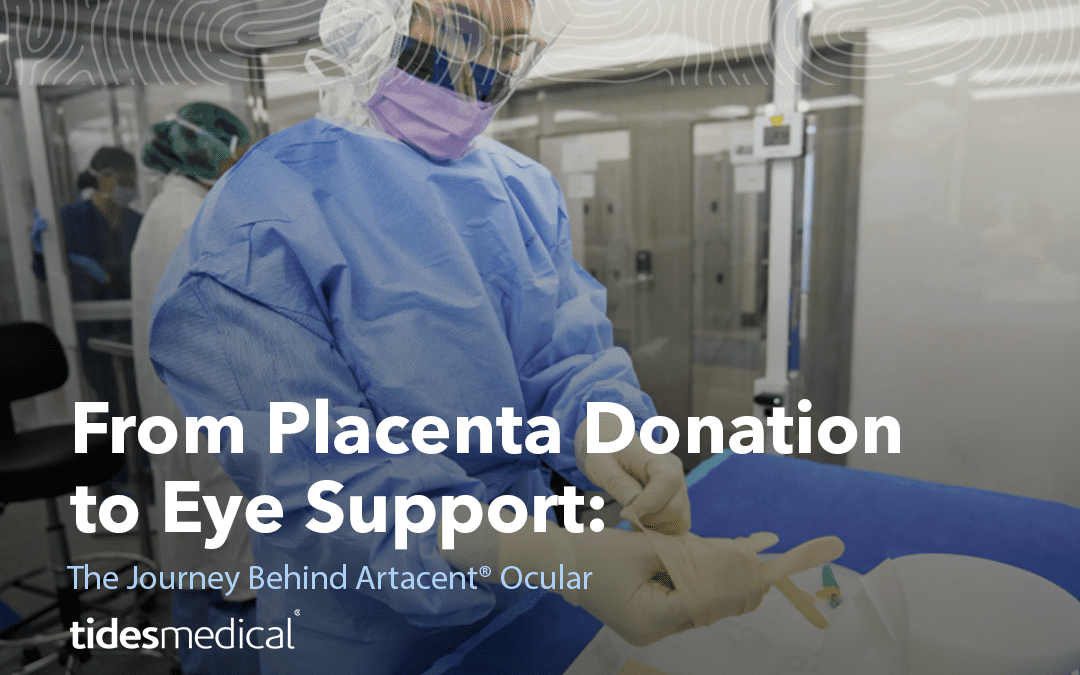
At Tides Medical’s tissue-bank facility, every placenta enters a controlled, sterile environment designed to protect biologic quality from start to finish. Processing takes place in an ISO Class 6 cleanroom, where air quality, particulate levels, and sterility are tightly regulated.
Here, trained technicians apply the Artacleanse® Process, a proprietary method developed by Tides Medical. The goal of this approach is twofold:
- Ensure safety and sterility: The process removes contaminants and prepares the tissue for medical use.
- Maintain biologic integrity: The process is intentionally measured step by step so that the natural characteristics of the amniotic membrane are preserved.
After cleansing, the graft undergoes terminal sterilization to ensure it meets standards for sterility. This step provides confidence for clinicians who rely on consistent quality.
The processed graft is then gently dried to preserve its structure while making it shelf-stable at room temperature. Unlike some biologic tissues that require freezing, Artacent Ocular can be stored for years without refrigeration — a major benefit for clinical convenience and accessibility.
Step 3: Manufacturing and Quality Oversight
Once processed and sterilized, the grafts move through Tides Medical’s manufacturing and quality-control workflow.
Tides maintains accreditation with the American Association of Tissue Banks (AATB), which sets rigorous standards for donation, processing, labeling, and distribution. The company also follows applicable FDA regulations governing human cells, tissues, and cellular and tissue-based products.
Every step — from donor screening to packaging — is documented, monitored, and quality-checked. This ensures that when clinicians reach for Artacent Ocular, they can trust the product’s consistency and sterility.
Because Artacent Ocular is shelf-stable at room temperature, clinics can easily store it without specialized freezers or equipment. This reduces logistical barriers and supports timely access when an ocular surface graft is needed.
Step 4: In the Clinic — A Natural Biologic Covering for the Eye
Artacent® Ocular is composed of 100% human amniotic membrane. In the clinic, it is used as a natural biologic covering placed on the ocular surface in a variety of eye-care procedures. The graft can be placed with either side facing up and typically does not require sutures — it naturally conforms to the eye.
Because the amniotic membrane retains its natural structure and proteins, the graft supports the eye’s surface during the post-procedure period. Its properties make it suitable for situations where clinicians want to maintain a stable environment for the ocular surface, support re-epithelialization, or help manage areas of tissue disruption.
Artacent Ocular’s thin, pliable nature, no foreign or rigid substances, and biocompatibility make it comfortable for patients while offering clinicians a dependable biologic option for ocular surface management.
Safety, Sterility, and Integrity at Every Step
From the moment a donor signs a consent form to the moment a clinician applies the graft, Tides Medical’s process prioritizes:
✔ Safety — through donor screening, aseptic processing, and terminal sterilization
✔ Sterility — ensured by cleanroom standards, validated sterilization methods, and strict quality control
✔ Integrity — maintained by a proprietary cleansing method designed to preserve the characteristics of the amniotic membrane.
This careful balance is what makes Artacent Ocular a trusted natural biologic covering option within the ophthalmic community.
By respecting the gift of placenta donation, adhering to rigorous standards, and using advanced biologic processing techniques, Tides Medical transforms birth tissue into a product that supports clinicians and helps maintain ocular surface stability for a wide range of needs.
To learn more about Artacent Ocular, placenta donation, or Tides Medical’s biologic processing standards, visit TidesMedical.com or contact the Tides Medical team for additional information. Their specialists can help clinicians explore product options, discuss ocular surface applications, and provide guidance on how Artacent Ocular may fit into your practice’s needs.
 Marc Stemler,
  Mora Melican, Ph.D., VP of Operations, Research & Development
 LESA CATALON,
 DAVID CASTILLE,




 JOSH WILLETT,
 JEFF MONTGOMERY,
 MIKE RIDDLE,
 BENJAMIN KIMBALL,
 DOUG PAYNE,